
The short answer
Yes, but the water quality decides whether it helps or hurts. Below roughly 10 parts per million (ppm) total dissolved solids (TDS), water evaporates off panel glass without leaving a visible residue. US municipal tap water commonly tests at 100–500 ppm — the EPA’s own secondary (aesthetic) guideline caps recommended levels at 500 ppm — and European municipal supplies vary by local water hardness in a broadly similar range. That is high enough that a handful of wash cycles will leave mineral spots, and high enough that repeated cycles turn those spots into bonded scale that is harder to remove than the dust you were trying to clean off in the first place.
Whether tap water is safe to use on your site is a question you answer with a TDS meter, not a blanket rule. The rest of this article covers the threshold, why the damage compounds, and what to do about it if your water tests too high.
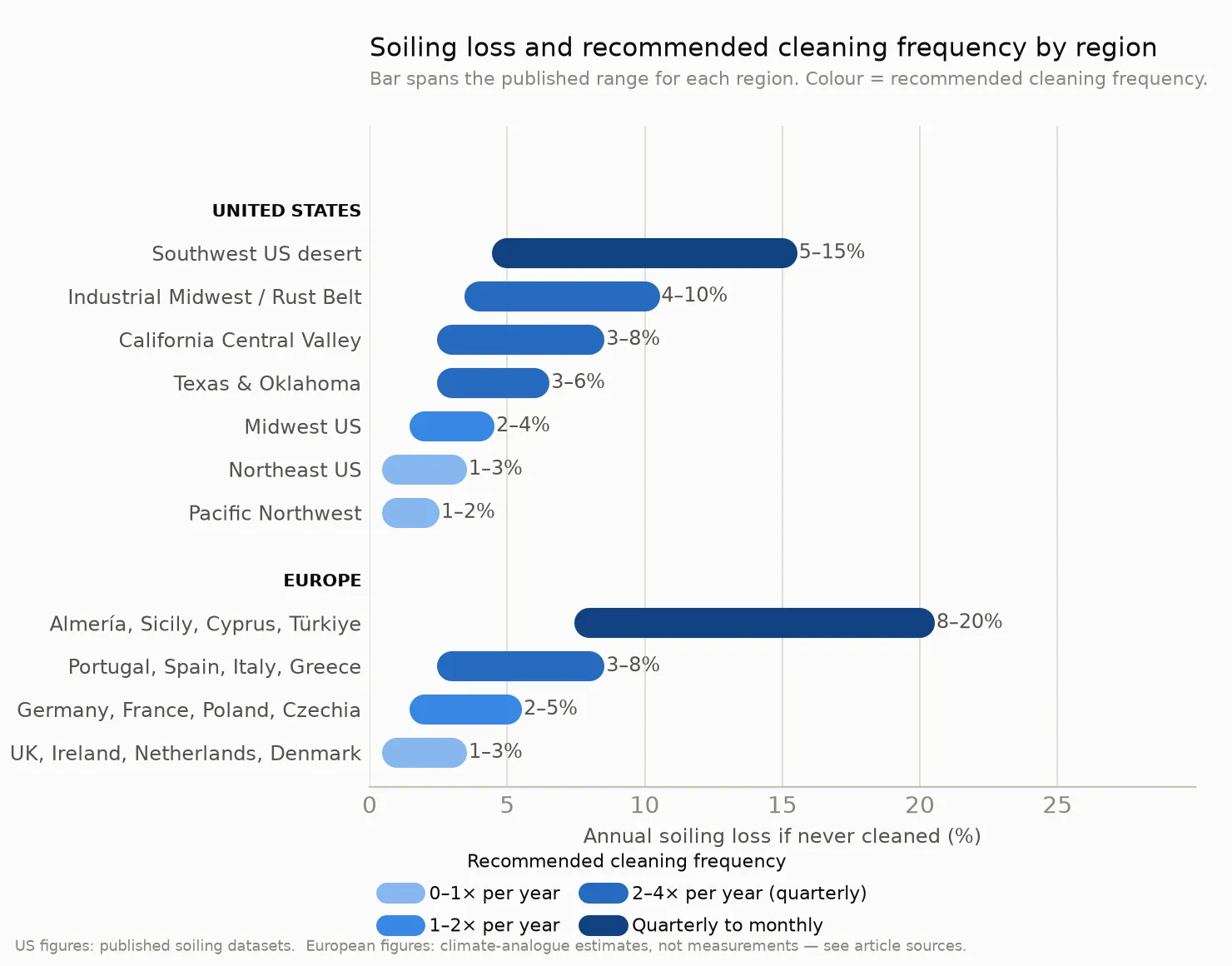
This article covers water quality only. For how often to clean by climate, see our companion guide, How Often Should You Clean Solar Panels? Water quality decides whether each individual wash helps or hurts; frequency decides how many times you do it. The two questions compound — using untreated hard water on a site that needs quarterly cleaning does four times the damage of the same water on a site that needs annual cleaning.
1. What TDS measures, and why it is the number that matters
Total dissolved solids is exactly what it sounds like: the combined mass of everything dissolved in the water — calcium, magnesium, silica, sodium, bicarbonates, and trace minerals — expressed in parts per million. It is a broader measure than “hardness,” which refers specifically to calcium and magnesium. A water sample can be low in hardness and still carry enough dissolved silica or sodium to spot glass on evaporation, which is why TDS, not hardness, is the number to track for cleaning water.
TDS is cheap to check. A handheld TDS meter (the same type used in aquarium and drinking-water testing) gives a reading in seconds and is standard equipment for any crew doing water-fed cleaning. Testing your actual supply matters because TDS varies significantly by region and even by season within the same municipal system — a published national average tells you little about the water coming out of your specific tap.
2. The TDS thresholds that determine whether tap water will spot
| TDS reading | What happens as the water dries on glass |
|---|---|
| 0–5 ppm | Spot-free in virtually all conditions, including direct sun |
| 6–10 ppm | Spot-free in shade or moderate humidity; risk rises in direct sun |
| 10–20 ppm | Visible mineral spotting likely |
| 20+ ppm | Spotting close to certain — panels typically need to be wiped dry by hand to avoid marks |
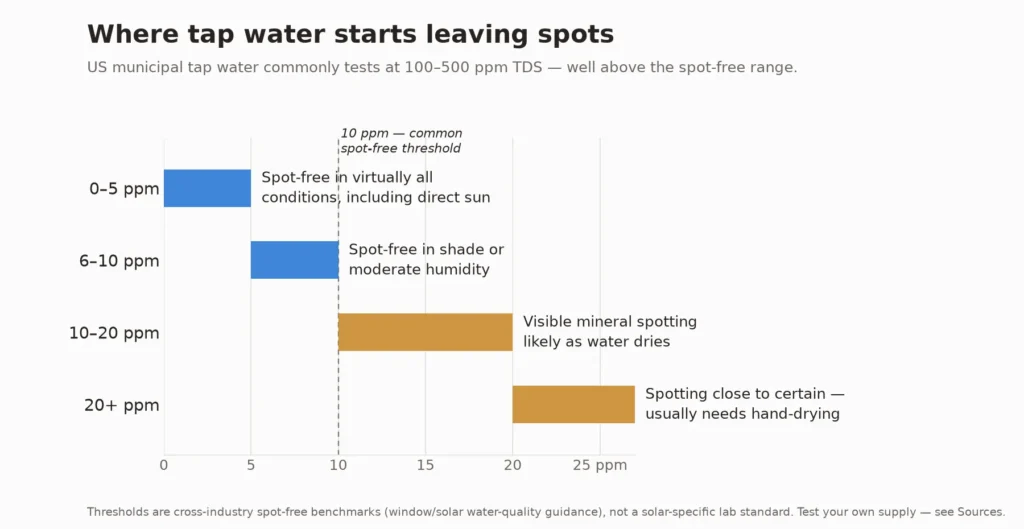
This 10 ppm figure originates in the spot-free rinse industry (window cleaning, vehicle detailing) rather than a solar-specific laboratory standard, but solar water-quality guidance cites the same threshold, and the underlying chemistry is identical — dissolved minerals left behind when water evaporates. Treat it as a well-corroborated benchmark, not a hard physical law: your own site’s outcome depends on your water’s specific mineral mix, glass temperature, and drying speed, which is why testing your own supply is worth the five minutes it takes.
3. Why hard water scale is worse than ordinary dust
Dust is loose and mechanical — it sits on the glass and, in principle, wipes or rinses off. Mineral scale is different: it forms when the water itself changes state. As a droplet evaporates, everything that was dissolved in it stays behind as a solid deposit, chemically bonded to the glass rather than resting on top of it.
| Dissolved mineral | Deposit it forms | Why it matters |
|---|---|---|
| Calcium (as calcium carbonate) | Chalky white scale | Builds up in layers with repeated wetting and drying |
| Magnesium (as magnesium hydroxide) | Fine white film | Often co-deposits with calcium; contributes to haze |
| Calcium sulfate | Denser, harder scale | More resistant to plain water or mild rinsing than carbonate scale |
| Dissolved silica | Glassy, tenacious film | The hardest of the four to remove; resists dilute acid and typical descalers |
The practical consequence is a compounding cycle rather than a one-time mark: a roughened, mineral-etched surface holds the next layer of dust and the next round of mineral residue more readily than smooth glass, so a panel that has been washed repeatedly with untreated hard water tends to soil faster between cleanings, not just look worse after each one.
We have not found a published, solar-specific timeline for how quickly light spotting becomes bonded scale — it depends on cycle count, UV exposure, glass temperature, and the specific mineral mix in your water, and we would rather say that plainly than invent a number. What is well documented is the direction: each wash with untreated hard water adds another mineral layer, and each layer is harder to remove than the last.
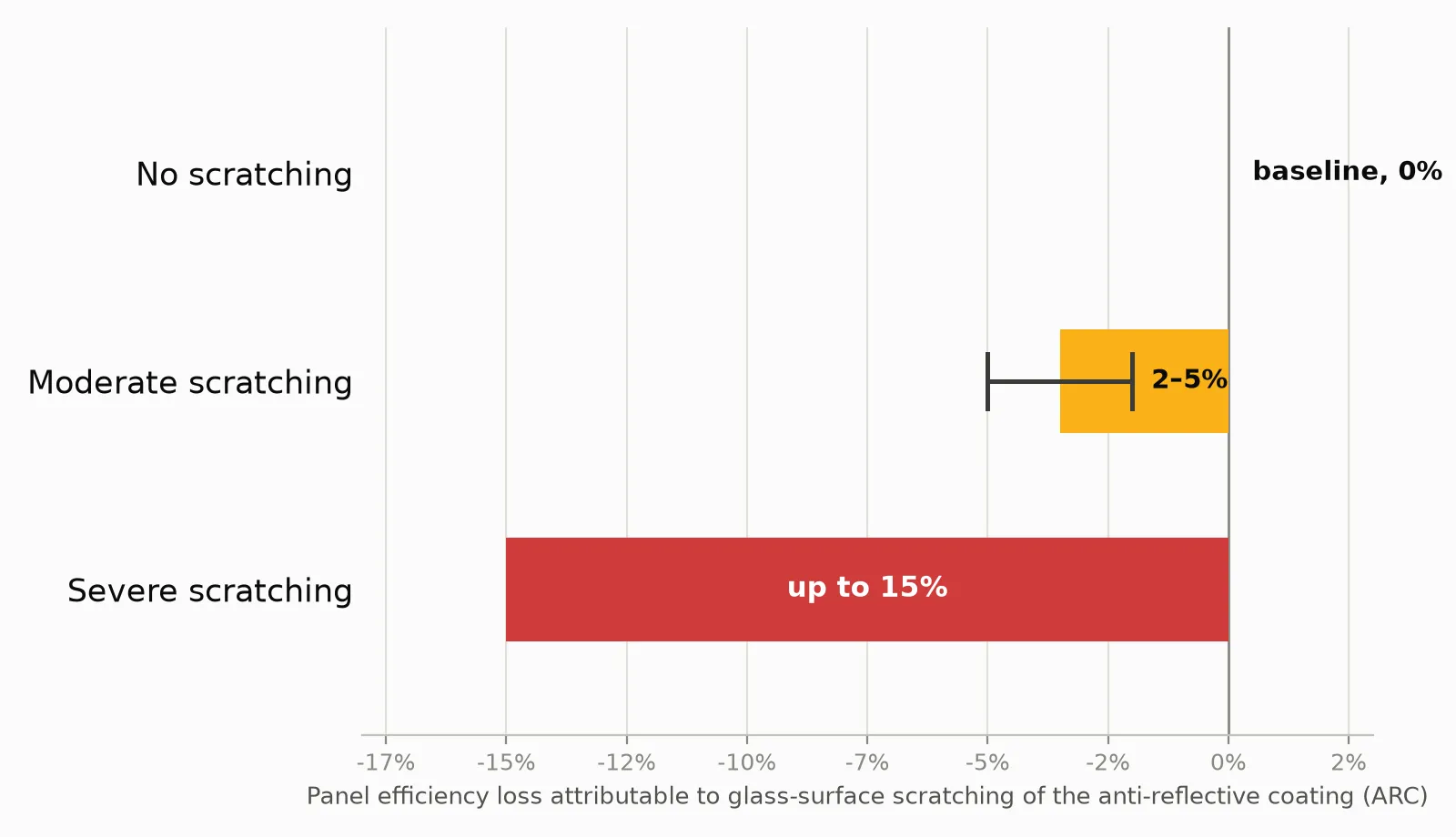
A factory-applied anti-reflective (AR) coating cannot be re-applied in the field once it is stripped or etched, which is why aggressive removal — scraping, strong acid, abrasive pads — is a last resort rather than routine maintenance. The lower-cost fix is upstream: treat the water so the deposit does not form, rather than remove it after it has bonded.
4. Comparing water treatment options: filtration, softening, RO, and DI
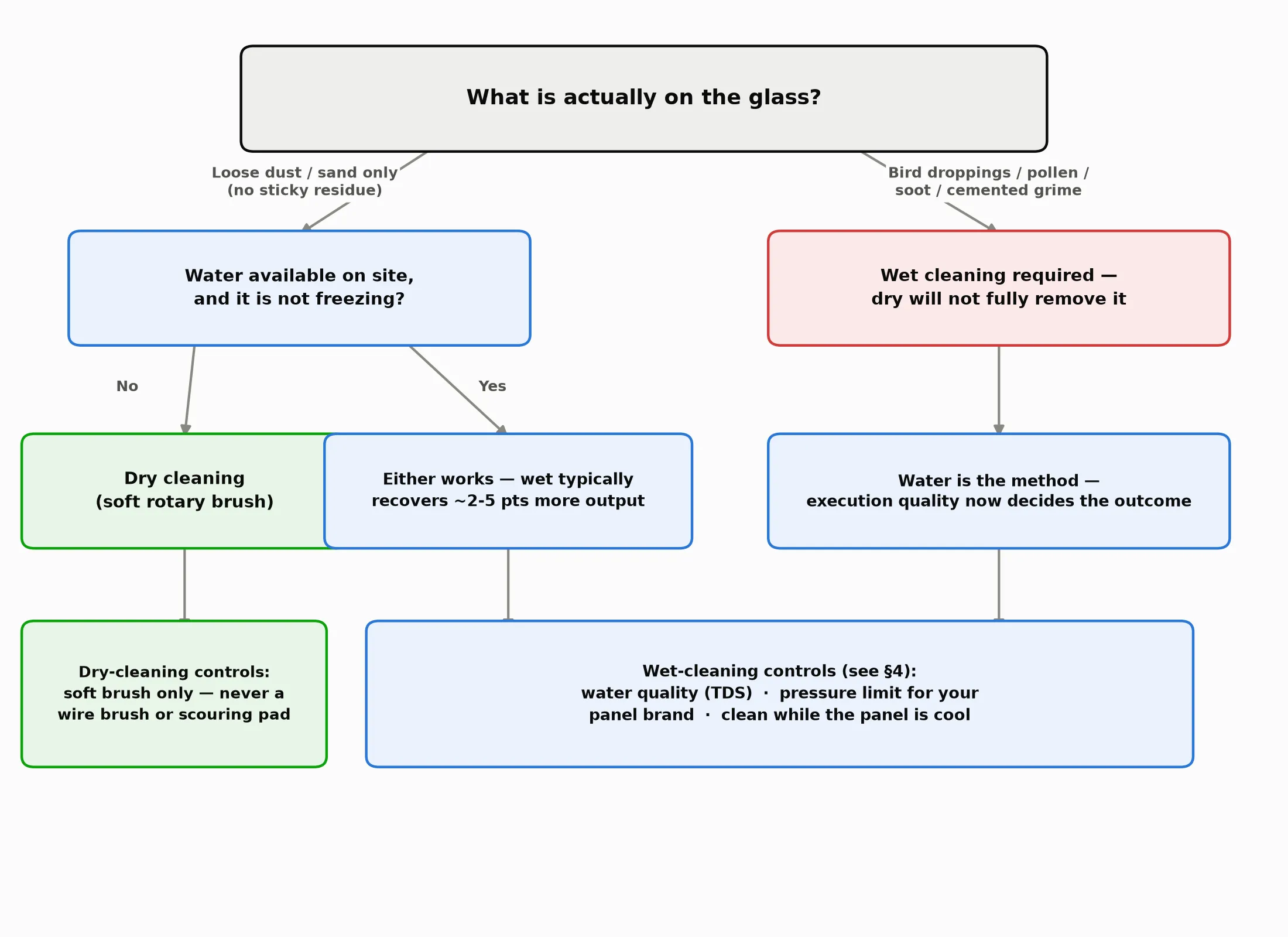
Four methods show up repeatedly in cleaning-water discussions, and they are not interchangeable. The most common misconception is that a water softener solves the spotting problem — it does not.
| Method | What it actually removes | Stops spotting? |
|---|---|---|
| Sediment / carbon filtration | Particulates, chlorine, organics | No — dissolved minerals pass through unchanged |
| Water softener (ion exchange) | Swaps calcium and magnesium for sodium; does not remove dissolved solids | No — TDS stays roughly the same, so sodium salts still spot on evaporation |
| Reverse osmosis (RO) | Rejects roughly 90–99% of dissolved solids | Yes, for most source water |
| Deionization (DI), used after RO | Residual trace ions RO leaves behind | Yes — the most reliable spot-free result, best used as a polishing stage rather than a first pass |
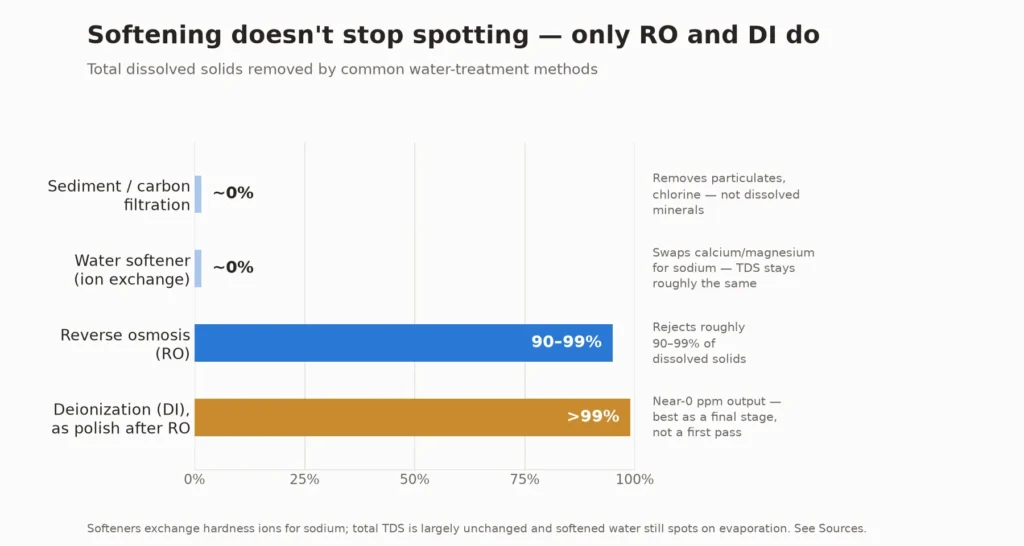
If your site already runs softened water for other purposes — irrigation, equipment cooling — that does not solve the cleaning-water problem. Softening protects plumbing from scale by swapping ion type; it does not lower total dissolved solids, so softened water still leaves spots. RO is the method that actually cuts TDS at volume, and DI is worth adding afterward as a final polish rather than running raw tap water through a DI resin bed directly, which exhausts the resin far faster than feeding it pre-treated water.
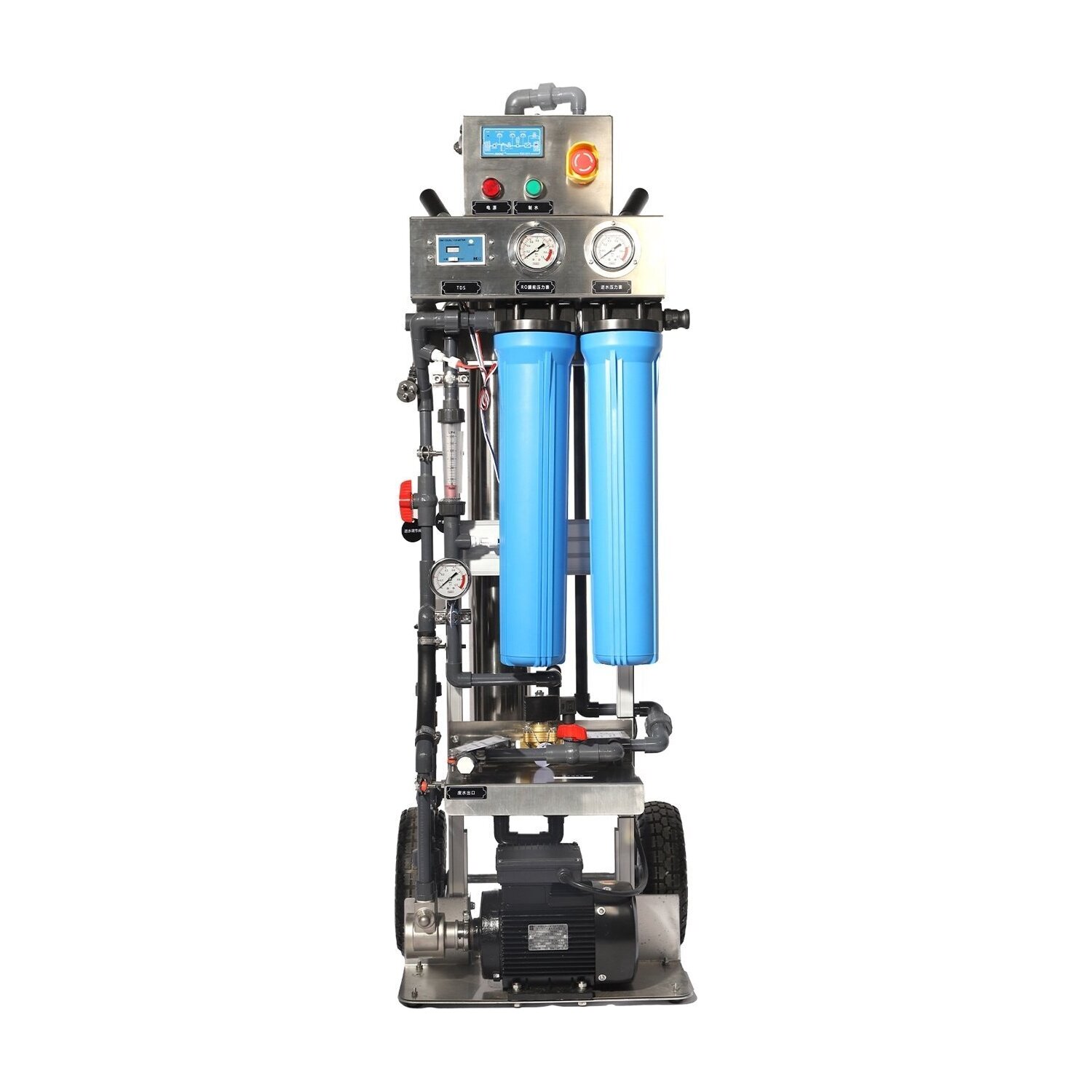
For sites that need volume, our A40 mobile RO system is built for this: 300–500 L/h output, rated for inlet water up to 1,000 ppm TDS and 10 NTU turbidity. The product page does not publish an output TDS figure, so treat the 90–99% reduction above as the general RO benchmark rather than an A40-specific guarantee, and verify against your own feed water if you need a precise number.
RO membranes and DI resin are consumables — their service life depends on your feed water chemistry and throughput volume, not a fixed calendar interval. We are not publishing a replacement schedule here because we have not confirmed one against your specific water quality; check manufacturer guidance for your actual TDS and turbidity readings.
5. Water use: metered spray vs. hose washing
Treating water is only worth it if the treated water actually reaches the glass instead of running off during an open hose-down. This is where equipment matters as much as water chemistry.
| Method | Typical water use | Basis |
|---|---|---|
| Manual hose / pressure washing | Roughly 0.1–1.2 gal (0.4–4.5 L) per panel per wash | Published estimates vary widely by technique and panel size — treat as an order-of-magnitude range, not a precise figure |
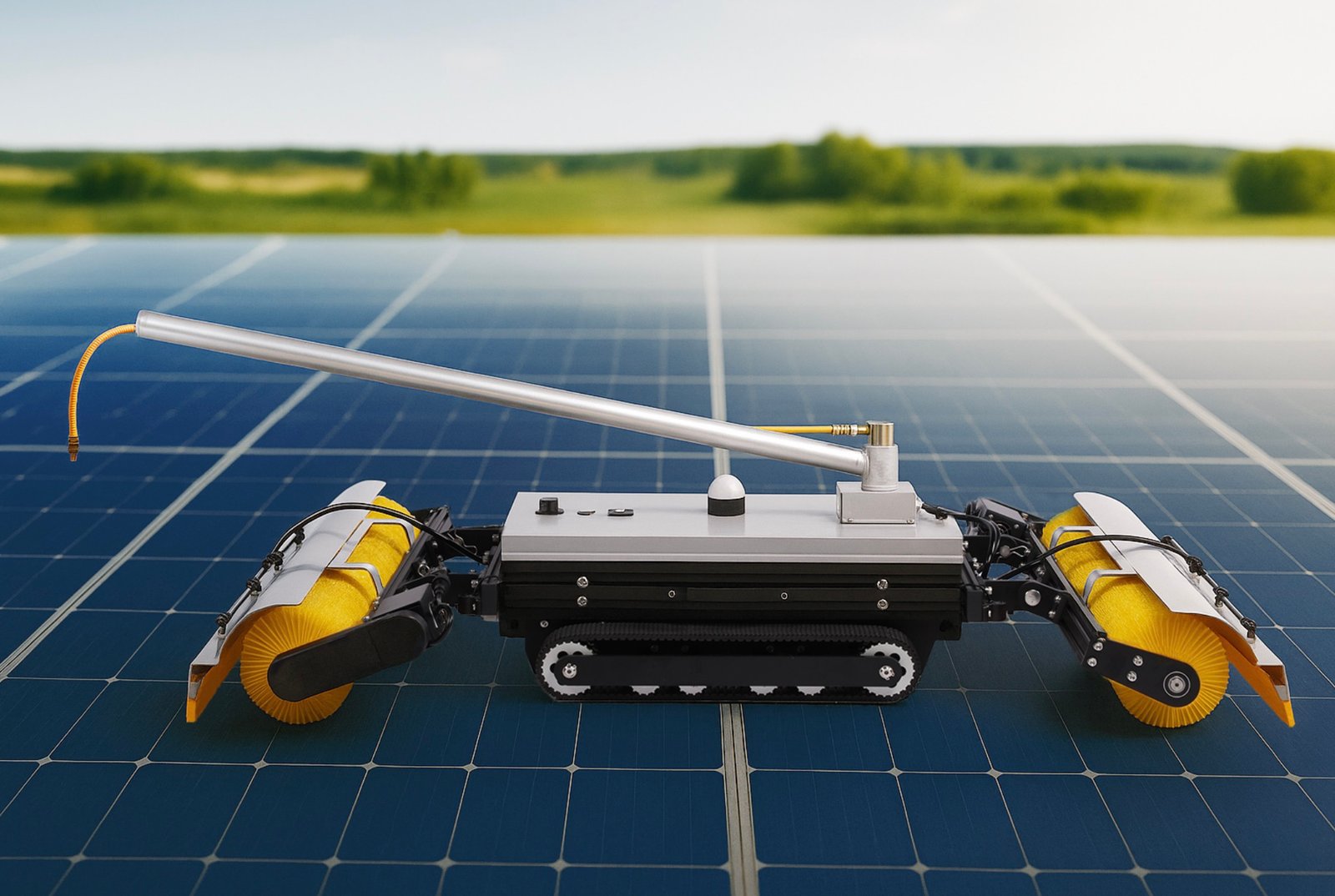
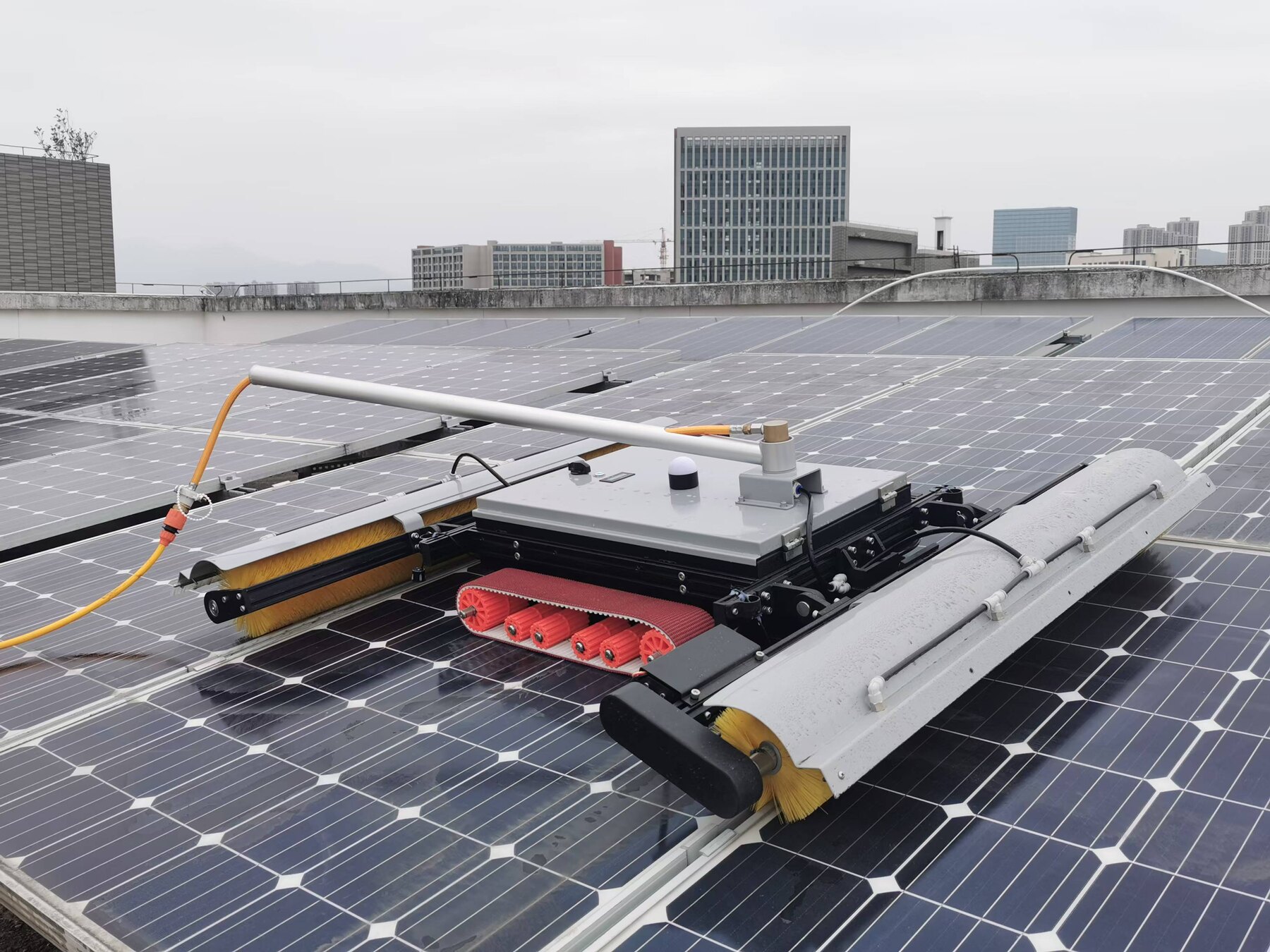
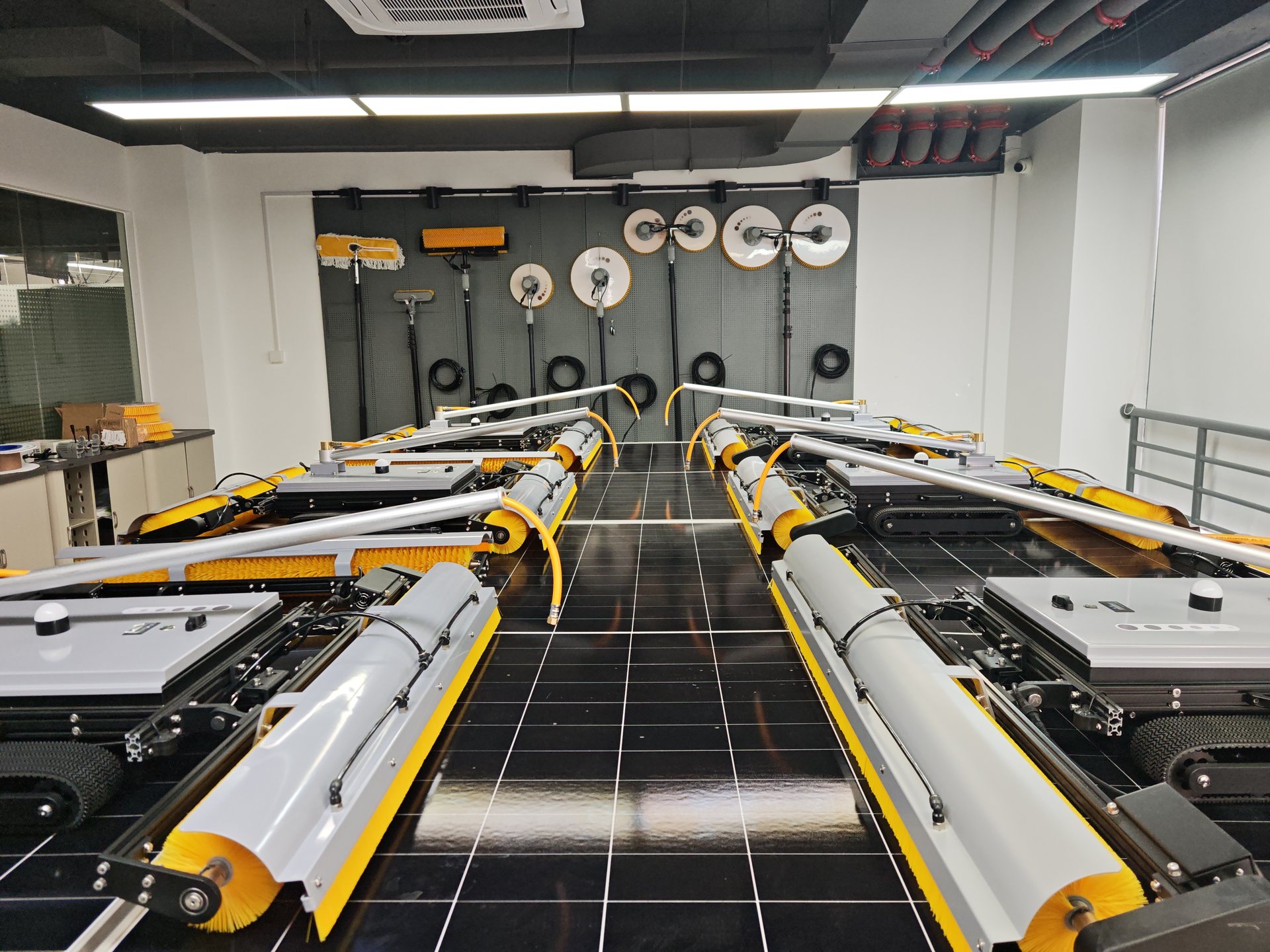
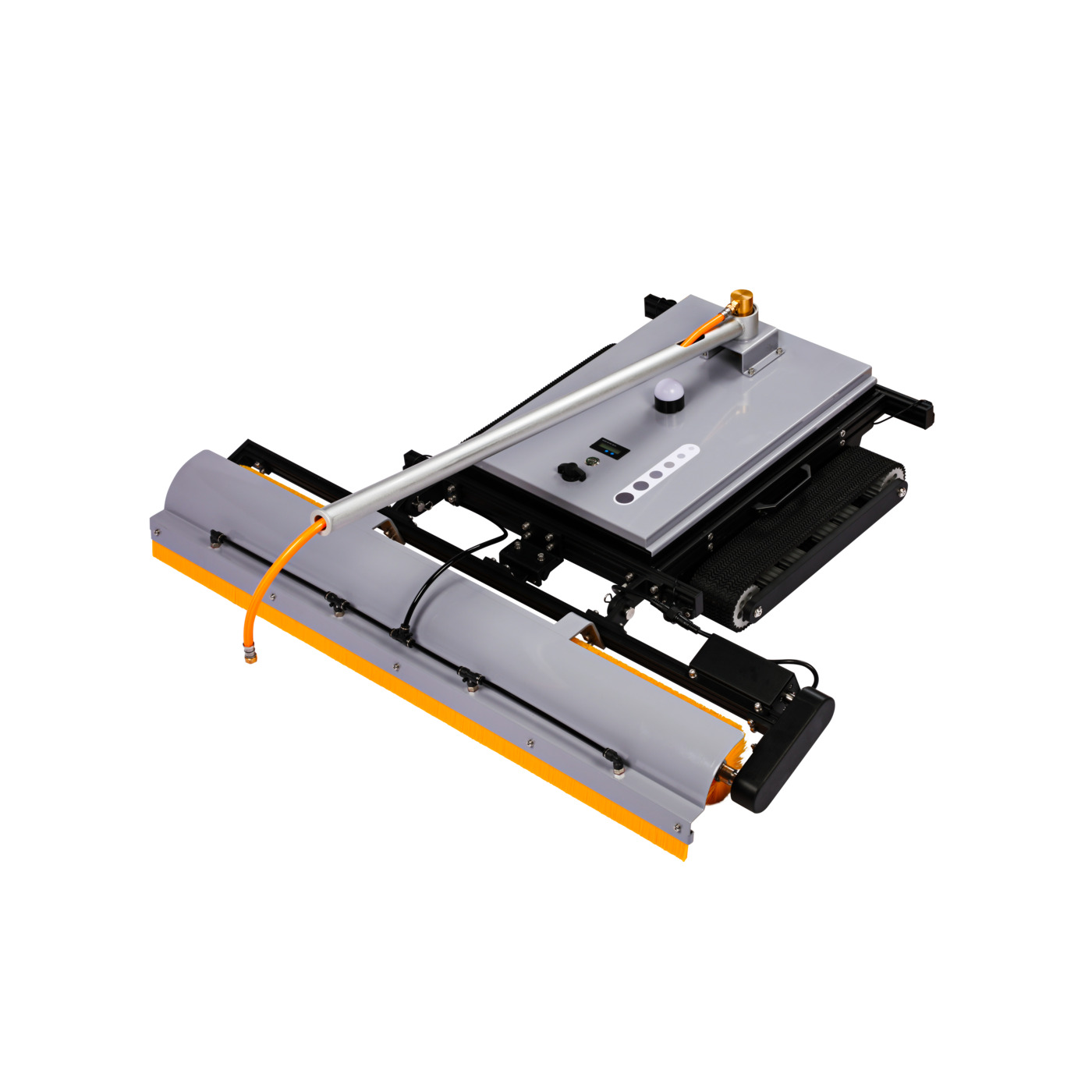
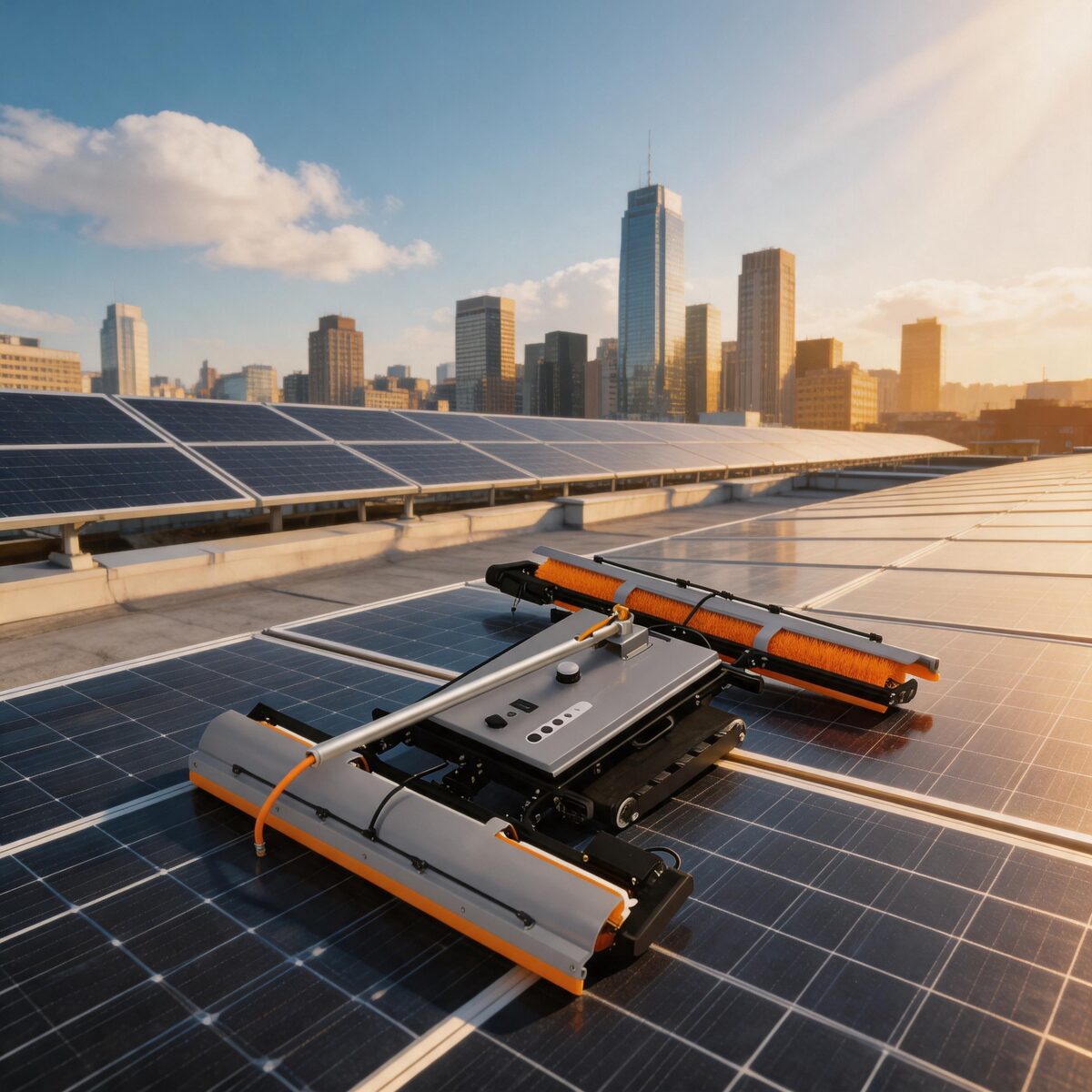
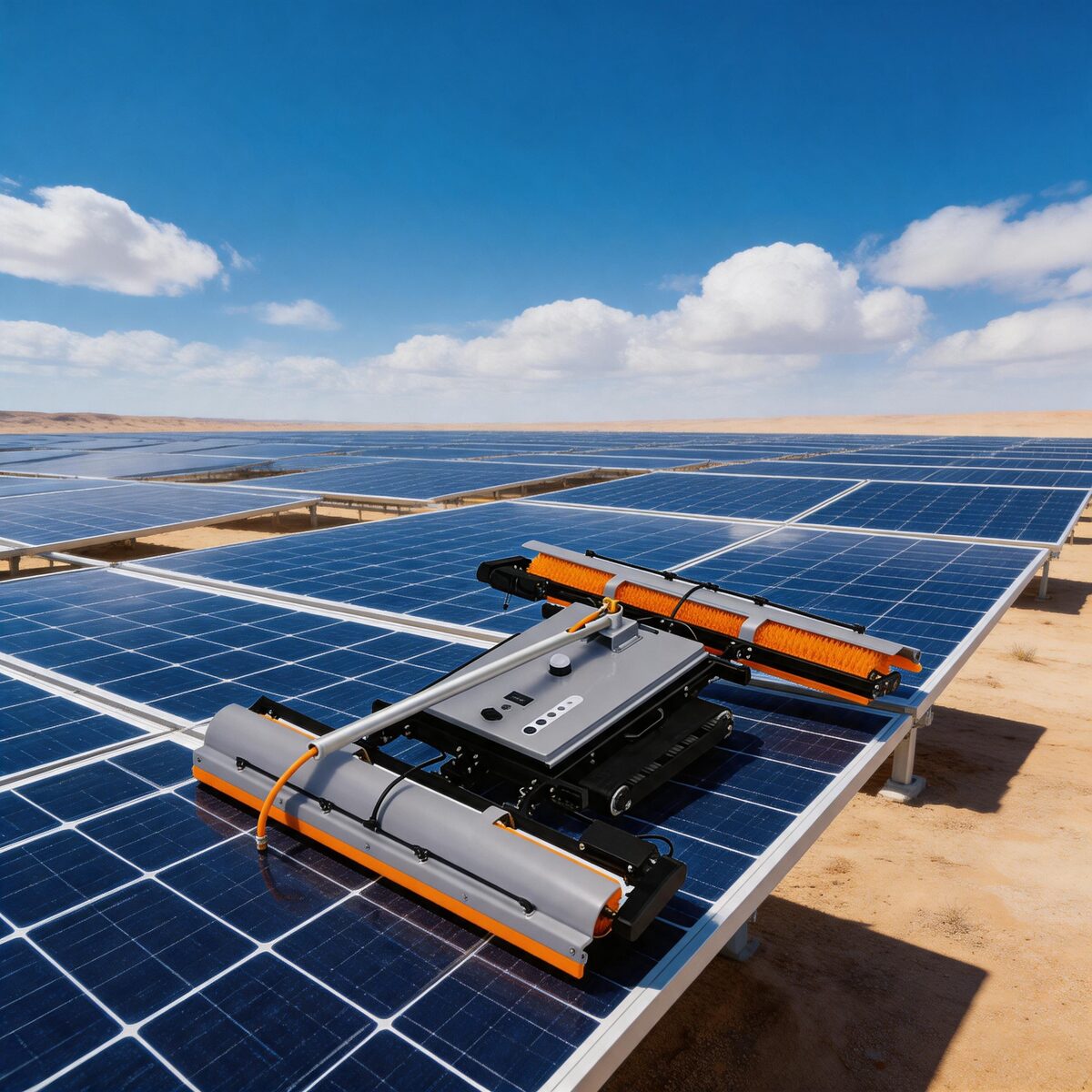
| R1 crawler robot, metered spray | Up to 1.84 L/min at the nozzle, calibrated per pass | Manufacturer spec — a per-minute rate, not directly convertible to per-panel use without site-specific dwell time |
Those two figures are not on the same basis — one is volume per panel, the other is flow rate per minute — and we are not going to force a conversion that would require assumptions about panel size and dwell time we have not verified. What the comparison does establish directly: hose washing sprays continuously and lets runoff carry most of that water off the array unused, while a metered crawler system doses water at a fixed rate as it passes, so a much higher share of what comes out of the nozzle actually contacts the glass.
Vendor case studies in the robotic-cleaning industry commonly report 75–90% lower total water use for metered/automated systems versus manual hose washing. We flag that range as vendor-reported rather than independently audited — treat it as directional, not a guarantee for your site. The practical implication for water treatment economics is straightforward either way: the less water you spray and lose to runoff, the less treated water your RO/DI system has to produce per panel, which is why treatment and metered application are usually worth planning together rather than separately. See the R2 crawler robot for the AC-powered, continuous-duty version of the same metered-spray approach.
6. When tap water is probably fine — and when it is not
Probably fine:
- Your own tap water tests below roughly 10 ppm TDS — uncommon, but it happens with some soft-water municipal supplies and rainwater-fed systems.
- You are doing an occasional light rinse that gets wiped dry before it air-dries — rare in any commercial O&M schedule, more realistic for a small residential array cleaned by hand.
- You already run RO or DI water for another purpose on site and can route it to cleaning at no extra cost.
Treat the water first:
- Your tested TDS is above roughly 10 ppm — this covers most municipal and well-water sources in the US and Europe.
- The site is cleaned more than a few times per year, since spotting damage compounds with each cycle (see section 3).
- The site is in a hot, high-irradiance climate, where water evaporates faster and mineral concentration on the glass surface happens before the deposit can be rinsed away.
- The site operates under a performance-guarantee or O&M contract where cumulative optical degradation from scale is a measurable liability.
For guidance on how often your specific climate actually requires cleaning — which changes how much this compounding effect matters — see How Often Should You Clean Solar Panels?
Frequently asked questions
Can I use tap water to clean solar panels?
Yes, if it tests below roughly 10 ppm TDS. Most municipal tap water in the US and Europe measures 50–400 ppm, which is high enough to leave mineral spots after a handful of washes and, over repeated cycles, to form bonded scale. Test your specific supply with a handheld TDS meter rather than assuming.
What TDS level is safe for cleaning solar panels?
Below 5 ppm is spot-free in essentially all conditions, including direct sun. 6–10 ppm is spot-free in shade or moderate humidity but riskier in full sun. Above 10 ppm, visible spotting becomes likely, and above 20 ppm it is close to certain unless the panel is wiped dry by hand.
Does a water softener stop water spots on solar panels?
No. A softener exchanges calcium and magnesium for sodium through ion exchange, which prevents scale in plumbing but does not lower total dissolved solids. The water still spots on evaporation — just with sodium deposits instead of calcium and magnesium ones.
Is reverse osmosis necessary for solar panel cleaning?
For any site cleaned more than occasionally, yes, if the local tap water tests above roughly 10 ppm TDS. RO removes roughly 90–99% of dissolved solids and is the standard bulk treatment method; deionization is commonly added afterward as a polishing stage for a fully spot-free result.
Can hard water permanently damage solar panels?
Repeated cleaning with untreated hard water can etch or degrade the anti-reflective coating on the glass, which is a factory-applied layer that cannot be re-applied in the field once damaged. The mineral deposits themselves also roughen the surface, which accelerates future soiling. The damage is cumulative and difficult to reverse, which is why treating the water is cheaper than remediating the glass later.
How do I test my water’s TDS before cleaning panels?
A handheld TDS meter, the same inexpensive type used for aquarium and drinking-water testing, gives a reading in seconds. Test the actual water source you plan to use for cleaning, since TDS varies by region and can shift seasonally within the same municipal supply.
Sources
- Basidewt — How Does a Spotless Water System Work? A Complete Technical Guide (0–5 / 6–10 / 10–20 / 20+ ppm spot-free tiers)
- Solaris Hydrobotics — Wet vs Dry Solar Panel Cleaning (solar-specific water-quality guidance; hard water reduces panel efficiency)
- AmPac Water — TDS Levels in Drinking Water: Complete Guide (US municipal tap water 100–500 ppm; EPA secondary standard)
- SpotFreeRinse.com.au — DI Water vs RO vs Water Softener vs Distilled (softening does not reduce TDS; RO removes 90–99% of dissolved solids)
- DIY Solar Forum — What Cleaner to Use to Rid Panels of Hard Water Stains (factory-applied AR coating cannot be recoated in the field)