The short answer
Dry vs. wet is not a philosophy to pick once and apply everywhere — it is a question you answer by looking at what is actually on the glass. Loose surface dust and wind-blown sand brush off dry without much trouble. Bird droppings, pollen, soot film, and dust that has been cemented on by dew or a light rain will not come off dry at all, and dragging a brush across them dry mostly smears the residue around rather than lifting it.
The method mismatch cuts both ways. Use wet cleaning where dry would do and you spend water you did not need to spend. Use dry cleaning where wet is actually required, and on top of leaving soiling behind, you risk a second problem: grit dragged dry across glass behaves like loose sandpaper, and the resulting micro-scratches in the anti-reflective coating are permanent. Section 3 has the numbers on that.
This article covers method selection and execution: dry vs. wet, and how to run each one safely. It does not re-cover cleaning frequency (see How Often Should You Clean Solar Panels?) or water quality (see Can You Clean Solar Panels With Tap Water?) — those are separate decisions that this article builds on in Section 4.
1. Match the method to what is actually on the glass
The deciding factor is soil type, not site preference. A cleaning-equipment vendor comparison of wet and dry methods puts it plainly: wet cleaning “excels” at bird droppings, sticky pollen, and industrial residues, while dry methods “may struggle with sticky residues or hardened bird droppings.” Loose, uniform dust is the one category where dry genuinely competes.
| Soil type | Dry cleaning | Wet cleaning |
|---|---|---|
| Loose dust / wind-blown sand | Removes effectively | Also effective, but uses water you may not need |
| Pollen / light organic film | Struggles — residue resists dry brushing | Removes effectively |
| Bird droppings | Struggles — tends to smear rather than lift | Required — water softens and lifts it |
| Soot / industrial residue | Struggles | Required |
| Rain-cemented or dew-cemented dust | Cannot lift once bonded to the glass | Required, may need longer dwell time |
If your site only ever sees loose dust — dry, low-humidity climates with no airborne organics — dry cleaning is a legitimate option, not a compromise. Everywhere else, water is doing real chemical work (softening and lifting a bonded residue), not just rinsing.
2. Dry vs wet, side by side
| Dimension | Dry cleaning | Wet cleaning |
|---|---|---|
| Water use | Zero | Manual hose/pole: roughly 0.1–0.5 gal (0.4–1.9 L) per panel. Metered or robotic application can cut that substantially — see note below. |
| Soiling it actually removes | Loose dust and sand only | Full range, including sticky and organic residue (see §1) |
| Glass-surface risk | Elevated without water as a lubricant — see §3 for the numbers | Lower in principle, but shifts the risk to pressure and panel temperature — see §4 |
| Best-fit scenario | Arid/desert sites, water-restricted or freezing locations, uniform loose dust | Heavy soiling, sticky/organic residue, salt-spray coastal sites, routine maintenance where water is available |
One vendor field comparison reports wet cleaning achieving roughly 2–5 percentage points better restoration of original output than dry methods on comparable soiling, and metered/robotic water application cutting consumption by up to ~90% versus manual hose washing. Both figures come from a single cleaning-equipment vendor’s own comparison rather than an independently audited study — treat them as directional, not a guarantee for your site.
3. The hidden cost of dry cleaning: micro-abrasion
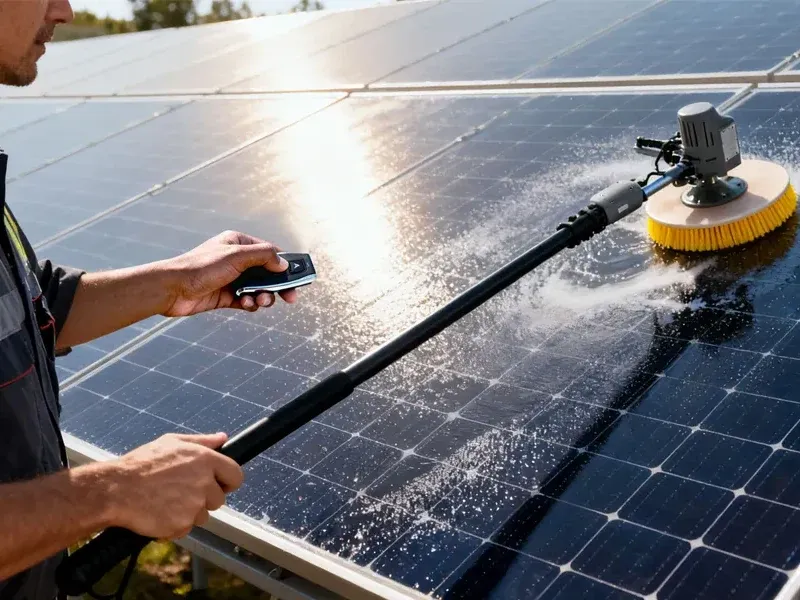
Water does more in a wet clean than carry dirt away — it lubricates. Without it, any grit trapped between a brush and the glass gets dragged rather than floated, and dragged grit behaves like sandpaper. A brush manufacturer’s own guidance is blunt about the consequence for sandy sites: “dry brushing should be avoided entirely, as it grinds particles into the glass surface.” Their recommended alternative is to rinse dust off the glass before any brush makes contact, rather than pushing a dry tool across it.
The damage this causes is to the anti-reflective coating (ARC), a factory-applied layer that cannot be re-applied in the field once it is scratched or stripped — so unlike a layer of dust, it is not reversible by cleaning again.
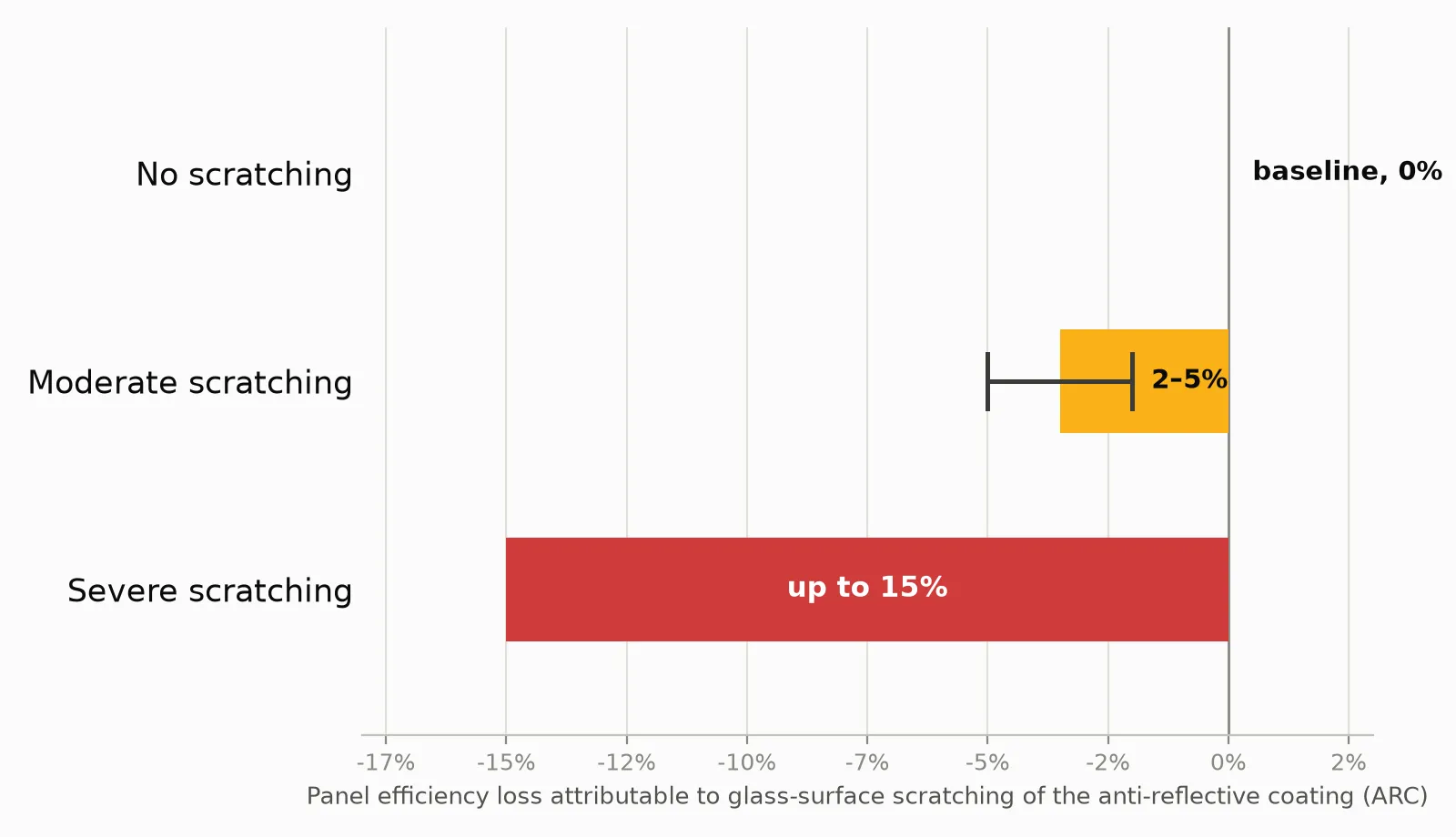
Wire brushes and scouring pads are the most common cause of avoidable scratching; the same source recommends soft materials and warns against abrasive tools on ARC-coated glass. If your site does need dry cleaning on loose dust, that guidance — soft rotary brush, never wire bristle or an abrasive pad — is the control that actually matters, more than the dry-vs-wet choice itself.
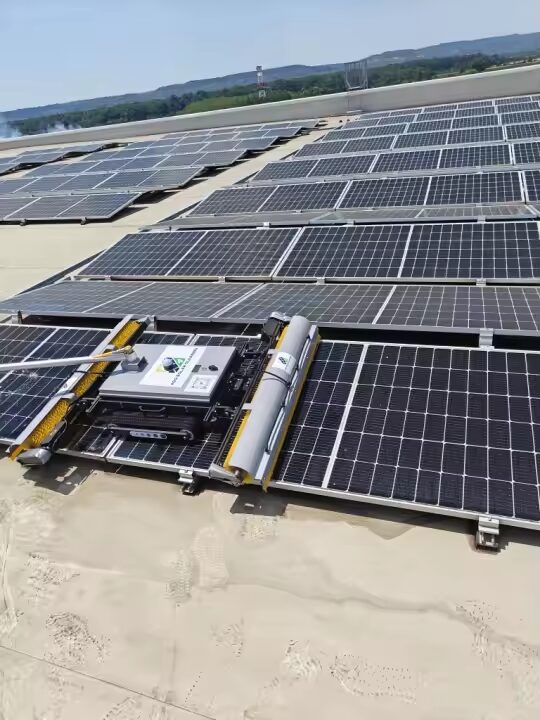
Our G4 roller-brush machine and R1 crawler robot both run in wet or dry mode on the same unit with a soft roller brush rather than a wire or abrasive tool. That does not make dry mode risk-free on gritty sand — it still depends on how much loose grit is on the glass — but it avoids the specific wire-brush and scouring-pad failure mode above.
4. If you clean wet, control these three variables
Water quality
Above roughly 10 ppm total dissolved solids, water leaves mineral spots on evaporation and, over repeated washes, bonds into scale that is harder to remove than the dust you started with. Most US and European municipal tap water tests well above that threshold. This is covered in full, with TDS tiers and treatment options, in Can You Clean Solar Panels With Tap Water? — if you are setting up a wet-cleaning program, read that before you read the rest of this section.
Water pressure
Module manufacturers cap wash pressure well below what a typical pressure washer puts out, and the limits are specific enough to quote directly:
| Manufacturer | Maximum pressure |
|---|---|
| Trina Solar | 700 kPa (~101 psi), front glass |
| JA Solar (ARC glass) | <690 kPa (100 psi); soft tools only |
| First Solar | 35 bar (500 psi) at the nozzle |
At Watersprayelephant, we offer a wide range of water pump products to meet the varying maximum allowable washing pressure requirements of different panels.
Panel temperature
Direct afternoon sun can bring a panel’s surface to roughly 60°C. Pouring noticeably cooler water onto glass at that temperature creates a rapid, localized temperature differential — the classic thermal-shock mechanism, the same reason a cold drinking glass can crack under hot water and vice versa — and it can stress or crack the glass.
Worth stating plainly, because it is easy to get backwards: the documented risk is cold water hitting a hot panel, not hot water hitting a hot panel. “Avoid washing with hot water on a hot panel” is not the mechanism at work here — the mismatch that causes thermal shock is between the panel’s temperature and the water’s temperature, and on a sun-heated panel the water is almost always the cooler side of that gap.
The practical fix is timing, not water temperature management: clean in the early morning or on an overcast day, when the panel has not yet heated up, rather than mid-afternoon. This control applies on top of water quality and pressure — all three are independent checks, not substitutes for each other.
5. A decision framework for your site
Putting Sections 1–4 together as a single path from soil type to execution controls:
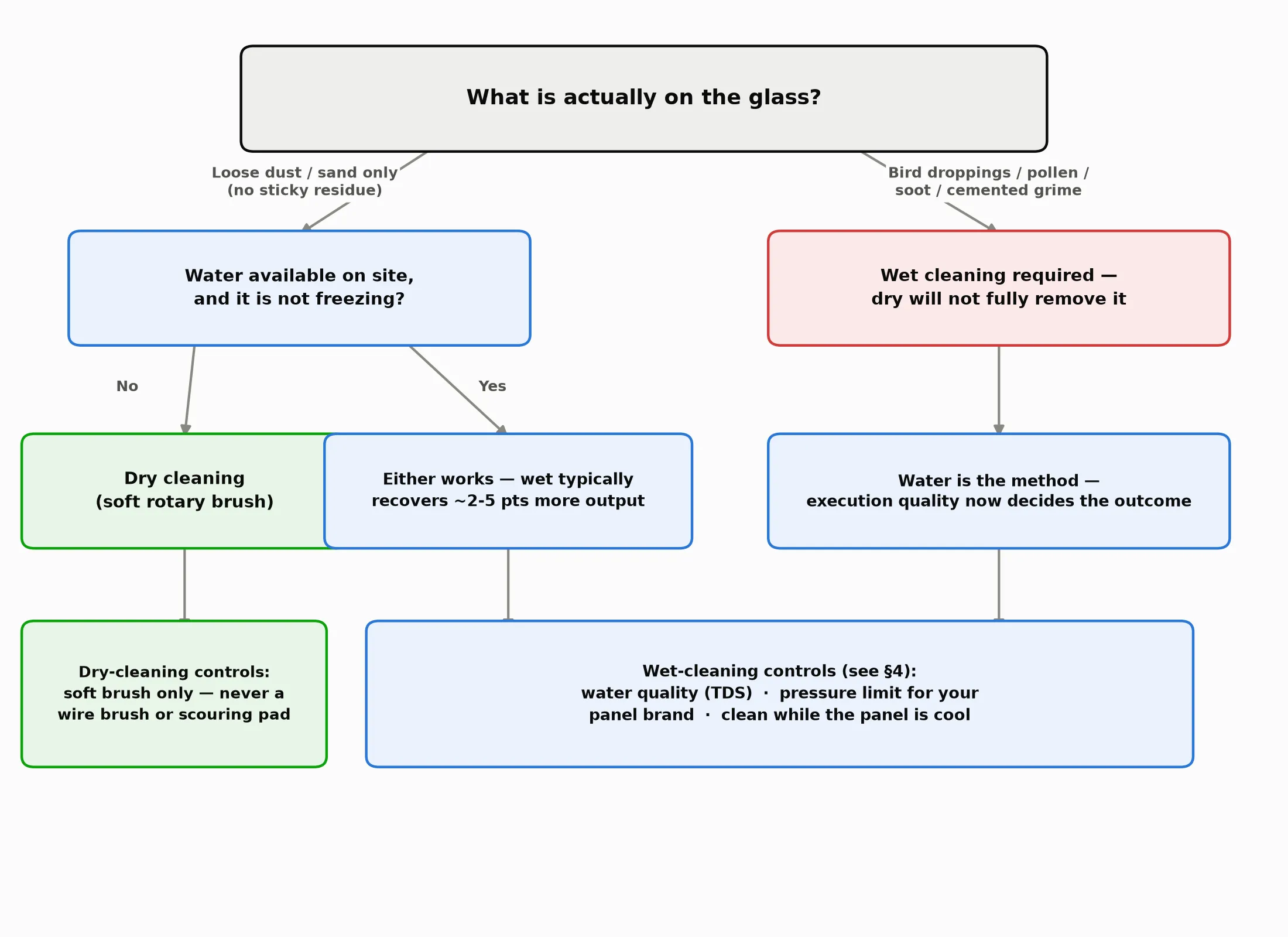
- Identify what is actually on the glass: loose dust/sand, or something sticky, organic, or cemented.
- Loose dust/sand, water available, site not freezing: either method works; wet typically recovers a few extra percentage points of output (§2).
- Loose dust/sand, no water available, water-restricted, or freezing conditions: dry cleaning with a soft rotary brush.
- Bird droppings, pollen, soot, or cemented grime, in any water situation: wet cleaning is required (§1).
- Whichever branch you land on, apply the matching controls before you start — soft-brush-only for dry (§3), or water quality / pressure / panel temperature for wet (§4).
Frequently asked questions
Can you clean solar panels without water?
Yes, for loose dust and sand — a soft rotary brush removes it effectively dry. It will not remove bird droppings, pollen, soot film, or rain-cemented dust; those need water to soften and lift. Dry cleaning also carries a documented risk of scratching the anti-reflective coating if grit gets dragged across dry glass; see the next question.
Is dry cleaning bad for solar panels?
It can be, depending on tool and soil type. Industry-reported estimates put moderate scratching of the anti-reflective coating at roughly 2–5% efficiency loss, and severe scratching at up to 15% — both permanent, since the coating cannot be restored once damaged. The main cause is dragging grit or using the wrong tool (wire brushes, scouring pads) dry; a soft rotary brush used only on loose, non-abrasive dust carries substantially lower risk.
Can you pressure wash solar panels?
Only within limits that are much lower than a typical pressure washer’s output, and the limit is set by your panel manufacturer, not by general advice. Trina Solar specifies a maximum of 700 kPa (~101 psi) on front glass; JA Solar specifies under 690 kPa (100 psi) for ARC-coated glass; First Solar caps nozzle pressure at 35 bar (500 psi). Check your specific panel brand before using any powered sprayer, and use a soft brush head rather than a bare jet.
Will cold water crack a hot solar panel?
Yes — and the mechanism runs opposite to what is sometimes assumed: it is cooler water meeting sun-heated glass that causes thermal shock, not hot water on a hot panel. Panel surfaces can reach roughly 60°C in direct afternoon sun; water applied at that point is almost always the cooler side of the gap, and the resulting temperature differential can stress or crack the glass. Clean during early morning or overcast conditions instead of mid-afternoon.
Which WaterSprayElephant products support both dry and wet cleaning?
The G4 roller-brush machine and the R1 crawler robot both operate in wet or dry mode on the same unit. Switching to dry mode does not remove the soil-type logic in Section 1 or the scratch-risk considerations in Section 3 — it just means you are no longer spending water on soiling that did not need it.
Sources
- Solaris Hydrobotics — Comparing Wet vs Dry Solar Panel Cleaning Technologies (soil-type fit, water-use figures, vendor-reported restoration comparison)
- Fortex Brush — The Brush for Solar Panel Cleaning Dilemma (moderate/severe scratching efficiency-loss estimates, wire-brush and dry-brushing guidance)
- The Green Watt — How to Clean Solar Panels (panel surface temperature, thermal-shock mechanism)
- Window Washing (South Africa) — Can You Pressure Wash Solar Panels? (Trina Solar / JA Solar / First Solar manufacturer pressure limits)